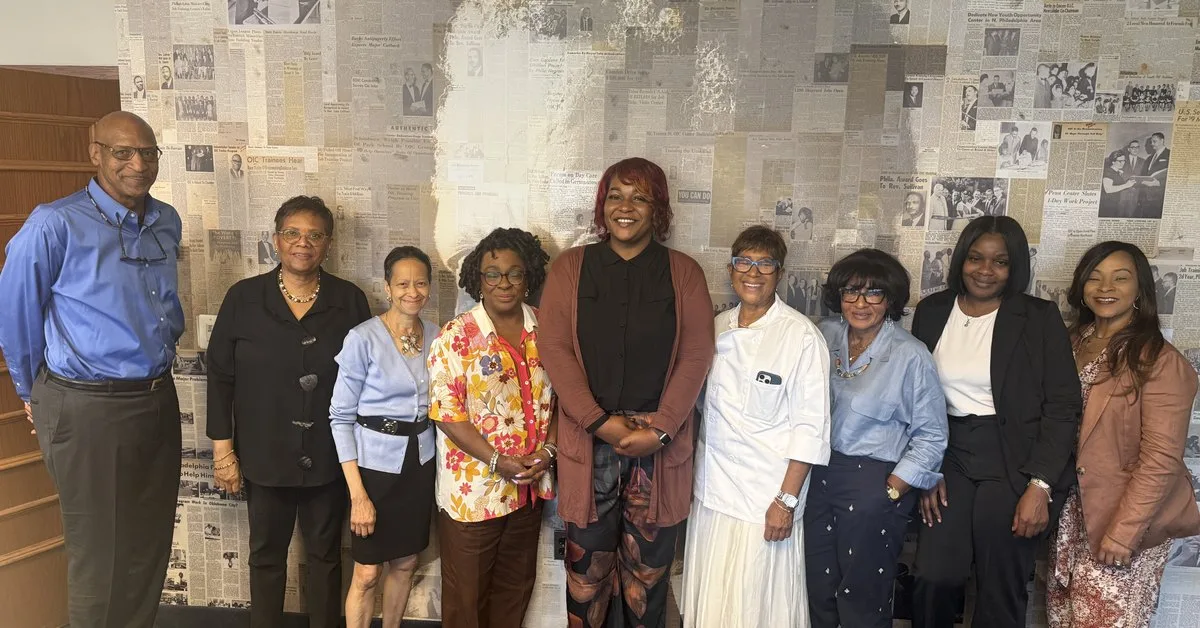
Earlier this week, OIC Philadelphia President & CEO Sheila Ireland was invited to speak at the prestigious Satell Institute Nonprofit Leadership Summit. The summit brought together nonprofit executives, corporate leaders, and philanthropists to discuss building effective partnerships for community impact. Below are her powerful remarks on the critical importance of trust and balanced power dynamics in creating meaningful collaborations.
Good morning and thank you.
I’m honored to be here today to discuss a critical element of successful partnerships: trust—which, let’s be honest, is sometimes the hardest part of the work.
Why Trust Matters
My career has been dedicated to workforce development, economic empowerment, and ensuring equitable access to opportunity. As President & CEO of an historic nonprofit founded by the great Reverend Dr. Leon Sullivan, OIC Philadelphia, I lead our work which lies at the intersection of workforce development, social justice and economic empowerment. For more than 30 years I have been in the people business, leading HR. Training, OD and Org Dev consulting across a number of both public and private organizations. Before OIC, I helped shape statewide workforce strategies as Deputy Secretary for Workforce Development of the PA Dept of Labor and Industry.

Over the past three decades, I’ve been an employer, a funder, a policymaker, and a service provider. Basically, I’ve sat in just about every seat at the table—except maybe the one with unlimited resources and no accountability. (If anyone finds that seat, let me know!)
But if there’s one thing I’ve learned, it’s that without trust, even the best-intentioned efforts fall apart. I was taught that trust should be extended but typically we only extend that trust as far as we believe we can handle the consequences of its potential betrayal. This perspective has shaped how I lead, how I build partnerships and how I work to balance the power dynamic in my relationships – both when I am the one wielding power and when I am not.
Trust & Power: The Core of Meaningful Collaboration
You see trust doesn’t exist in a vacuum. It’s deeply tied to power dynamics.
Too often, partnerships between corporations and nonprofits, funders and grantees, even nonprofits and the communities they serve feel one-sided. One side holds the purse strings, the other side does the work, and somehow, trust is supposed to just magically appear in the middle.
That’s not how real collaboration works. If trust is the foundation, shared power is the scaffolding. Without it, we’re just leaning on good intentions—and I think we’ve all learned by now that good intentions alone won’t keep the lights on.
But here’s the challenge: how do we move from a place of power imbalance to a place of mutual respect and trust?
I believe it starts with understanding and speaking the “love language” of those we engage.
Data + Storytelling = Trust & Results
Now, building trust is not a simple thing. It’s earned through transparency, accountability, and proof of impact.
And that’s where data and storytelling come in.
Numbers alone don’t inspire action. Stories alone don’t prove effectiveness. But together? That’s where the magic happens.
Let me give you an example.
OIC Philadelphia focuses on serving the 19122 zip codes and six surrounding zip codes—communities that reflect the deep systemic challenges of poverty and oppression. Our 19133-zip code has a 32.6% poverty rate. There are harsh realities to deal with in a community that we serve and stunning success stories that support our belief in human possibilities. The story of our work can be told in many ways, but when we’re building relationships based on trust, we must tailor our approach to our audience.
One of our most trusted partnerships is with the Pennsylvania Convention Center. We’ve built a workforce pipeline that not only fills jobs but transforms lives. It’s a model of how trust, balanced power, and strategic investment create sustainable impact.
And if you don’t believe me, I invite you to read Satell’s latest newsletter. (Because nothing says “trust” like a good third-party endorsement, right Michael?)


Final Thoughts
So, how do we build trust in a way that balances power? By using the currency of the realm, you are in.
Trust is the currency of social good. When nonprofits and corporations establish trust through data-driven storytelling and impact measurement, they don’t just prove their effectiveness, they inspire action, drive investment, and create lasting change.
Let’s commit to telling the right stories, backed by the right data. Together, we can build stronger partnerships, more equitable opportunities, and a future where trust isn’t an obstacle—it’s the foundation.
Thank you.