Author: Sheila Ireland, President & CEO, OIC Philadelphia
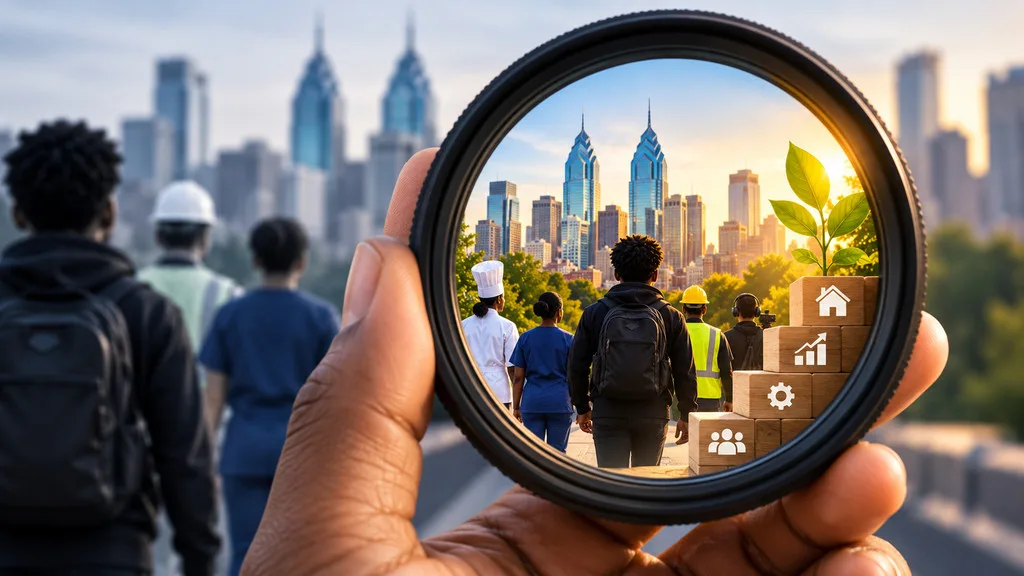
For more than six decades, OIC Philadelphia has helped people prepare for work, and mission remains essential. A good job creates income, stability, and a pathway toward greater economic security.
But economic mobility requires more than income alone. It also requires the ability to build assets and participate in the economy as an owner.
Employment creates income. Ownership creates assets. Philadelphia needs both.
Philadelphia has a significant business ownership gap.
A 2025 City of Philadelphia analysis found that Black residents represented approximately 44 percent of the city’s population but owned only about 5 percent of its small businesses. Latino residents represented about 17 percent of the population but owned approximately 4 percent.
The Federal Reserve Bank of Philadelphia has described business ownership as “integral to wealth building and employment in communities of color.”
That distinction matters.
Business ownership is not simply about becoming your own boss. A successful business can become an asset. It can create income, build equity, employ other people, and eventually become something of value that can be transferred to another generation. That is especially important in communities where poverty has persisted for decades and where residents have had fewer opportunities to accumulate assets.
We cannot address that challenge through employment alone.
Workforce development has become very good at measuring employment outcomes. We track credentials, job placement, starting wages, retention, and advancement. At OIC Philadelphia, we care deeply about those measures because training should lead to meaningful employment and stronger earnings.
But wages tell only part of the economic mobility story.
Long-term financial security also depends on whether people can save, purchase homes, build retirement assets, invest, and, for some, own businesses.
A paycheck supports a household today. An asset can strengthen that household tomorrow.
That is why I believe workforce organizations should begin thinking more deliberately about asset creation as part of economic mobility.
That thinking is already shaping our work at OIC Philadelphia.
Through our Food Entrepreneurship Program, we are helping aspiring entrepreneurs move from having a skill or product to understanding how to build an enterprise. Participants learn business modeling, pricing, branding, marketing, financial management, customer development, and access to capital, while also beginning to test their ideas in the marketplace.
The program is designed around a simple premise: talent alone is not enough. A great cook may know how to create an exceptional product, but building a sustainable business requires a different set of skills. That transition—from making something to building something—is where ownership begins. And when that business starts generating revenue, acquiring equipment, hiring employees, or winning contracts, a skill has started becoming an asset.
We should also be careful not to romanticize entrepreneurship.
Telling someone to start a business is not a wealth-building strategy. Businesses need capital, customers, technical assistance, banking relationships, mentors, and access to markets. The Philadelphia Fed has documented persistent disparities in access to financing for businesses owned by people of color.
That means entrepreneurship programs cannot stop at classroom instruction. Emerging business owners need an ecosystem around them.
That is why OIC’s Food Entrepreneurship Program is strengthened through partnerships with organizations such as Temple University’s Small Business Development Center and JPMorgan Chase. Our role is not simply to encourage entrepreneurship. It is to connect entrepreneurs to the knowledge, capital, relationships, and customers they need to survive and grow.
Workforce development has spent decades creating talent pipelines into growing industries. We should bring the same discipline to creating pathways to ownership.
Not everyone who comes through OIC should become an entrepreneur. For many people, economic mobility will come through employment and career advancement. But for those with the talent, discipline, and vision to build businesses, there should be a credible pathway from skill to enterprise and from enterprise to asset creation.
That idea is deeply consistent with the legacy of Rev. Dr. Leon H. Sullivan. His vision extended beyond employment into business development, investment, and economic self-determination. He understood that there is a difference between participating in an economy and having ownership within it.
Both matter.
For generations, workforce development has focused on helping people earn more. The next evolution is helping more people build and own assets as well.
A job can change a life. A successful business can change a family. And when more residents own businesses that grow and hire, ownership can begin changing the economic trajectory of a community.
At OIC Philadelphia, our Food Entrepreneurship Program is one way we are beginning to build that pathway. We are not simply preparing people to participate in the economy.
We are creating pathways for them to own a piece of it.